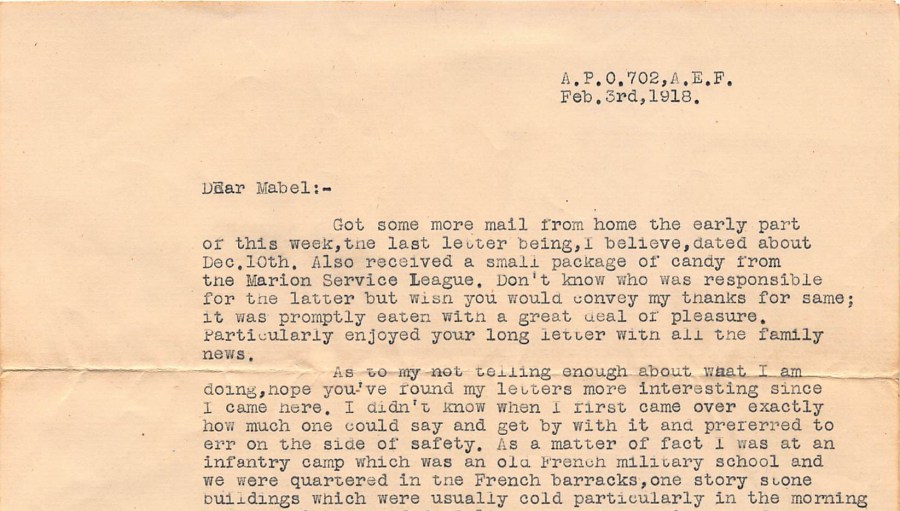
February 3, 1918. “The big event of the past week was the Bosche air raid.”

[Feb 3, 1918 to Mabel] Monty’s letter to Mabel is more open and revealing than the content of the letters to his mother, an apparent greater honesty between siblings and maybe trying to protect mother from details, though since both Mabel and her mother live in the same household, there is no doubt mother will expect to read the letter.

Monty starts with thanks to the Marion Service League for their Christmas package which contained candy for which he asks Mabel to convey his thanks. He is responding to her “long letter with family news.”

Apparently she has asked for detail. Rather than giving the earlier censorship excuse—while nevertheless explaining that he erred on the side of caution when he didn’t know how much one could say and get away with it—he launches into detail describing his first stop as “an old French military school” where the one story stone barracks “were usually cold particularly in the morning when reveille sounded.” He then goes into detail about his three day trip in November 1917 when he was “at Marseilles overnight and part of one morning and at Nice two days.” On the first day, “five of us took a machine and went over to Monte Carlo and Menton, driving in half a mile of the Italian border, stopped at Monte Carlo for lunch and had a look at the Casino.”

He then describes “the big event of the past week” which was “the Bosche air raid.” He supposes she has gotten details from the papers but he goes on to tell his tale: It was a beautiful moonlight night and I was returning from a call on some friends about 11:15 when the alarm was sounded.

Walked on to the Place de l’Opera and stopped there with quite a crowd to watch the French defending planes which were up all over the city. You could see them only when they showed their signal lights. After watching them for some ten or fifteen minutes, I began to think it was another false alarm—there was such a one just before Xmas—and walked over a couple of blocks down the Boulevard des Italiens toward my hotel. Stopped again on the corner of my street to have another look and then heard for the first time the anti-aircraft guns going on the outskirts of the city. Still didn’t think much about it until that time the first bomb dropped in about 200 yards of where I was standing, luckily around a corner. A second later another one dropped about a quarter of a mile the other side and I heard others in other parts of the city. About this time I decided along with the rest of the crowd that a house was a better place than the street and went on to my hotel.

In the safety of his hotel, he describes “nearly everybody in the lobby in various states of deshabille.” Apparently the lobby was considered the safest place during an air raid though curiosity provoked “occasional excursions into the street to see how things were going.” The excitement was over by 1:15. “Went over next morning to look at this place where the bomb had dropped so close and was surprised it didn’t make a bigger hole. The hole was only about four feet across and 18 inches deep. It certainly took out all the glass in the neighborhood, however, and twisted up to a considerable extent the iron shutters of a bank building opposite where it hit. Saw another place where a bomb just took off clean the fifth and sixth stories of a house.”

His interest then turns to tobacco. “Was glad to hear that more cigars have been on their way since the first of December and hope they’ll come in soon as have been out for several days and a decent cigar here costs a franc to a franc and a half.” The commissary carries them “at a reasonable price” but the supply is unreliable. “Now they’ve had none for three weeks.” He’s still expecting his mother’s shipment of pecans to show up, probably a Christmas gift from her own orchard.

As he closes he slips in a social note: “Met a whole flock of Counts and Countesses at a reception this past week.” He is looking forward to “two more such affairs this week.” The “affairs” are a “pleasant diversion” though there is no dancing, “the amusement being conversation, music and sometimes bridge.” His entrée into this world of royalty is through “an American lady who has lived over here for thirty years, knows the real French people and is very interested in having American officers meet these people.”


Transcribed Letter:

[first typed letter from TCM]

APO 702 AEF February 3, 1918 Dear Mabel:- Got some more mail from home the early part of this week, the last letter being, I believe, about Dec. 10th. Also received a small package of candy from the Marion Service League. Don’t know who was responsible for the latter but wish you would convey my thanks for same; it was promptly eaten with a great deal of pleasure. Particularly enjoyed your long letter with all the family news.

As to my not telling enough about what I am doing, hope you’ve found my letters more interesting since I came here. I didn’t know when I first came over exactly how much one could say and get by with it and preferred to err on the side of safety. As a matter of fact I was at an infantry camp which was an old French military school and we were quartered in the French barracks, one story stone buildings which were usually cold particularly in the morning when reveille sounded. Believe I wrote you in one of my letters from there about the trip and made to Marseilles, Nice and Monte Carlo in the middle of November. It was most pleasant but of course hurried as I had only three and a half days leave. was in Marseilles overnight and part of one morning and at Nice two days. The first day five of us took a machine and went over to Monte Carlo and Menton, driving in half a mile of the Italian border, stopped at Monte Carlo for lunch and had a look at the Casino. It’s the prettiest country I ever saw, I imagine a good deal like Southern California. That was my only trip of any interest while at this camp and, as you should have known a month ago, I have now been at the same station for a little over two months.

The big event of the past week was the Bosche air raid. Suppose you got the particulars the next day in the home papers. It was a beautiful moonlight night and I was returning from a call on some friends about 11:15 when the alarm was sounded. Walked onto the Place de l’Opera and stopped there with quite a crowd to watch the French defending planes which were up all over the city. You could see them only when they show their signal lights. After watching them for some ten or fifteen minutes I begin to think it was another false alarm – there was such a one just before Xmas – and walked on over a couple of blocks down the Boulevard des Italiens toward my hotel. Stopped again on the corner of my street to have another look and then I heard for the first time the anti-aircraft guns going on the outskirts of the city. Still didn’t think much of it until about that time the first bomb dropped in about 200 yards of where I was standing, luckily around the corner. A second later another one dropped about a quarter of a mile the other side and I heard others in other parts of the city. About this time I decided along with all the rest of the crowd that a house was a better place than the street and went on to my hotel. It was funny in a way to see how the crowd cleared off the Boulevard just to soon as those two bombs dropped. In my hotel I found a nearly everybody in the lobby in various states of deshabille, it being considered healthier around the ground floor, and there we remained with occasional excursions into the street to see how things were going until things quieted down about 1:15. I hadn’t heard enough to think there was near as much damage as there was as shown by the official communiqe [sic] and was surprised to learn the whole story. Went over next morning to look at the place where this bomb had dropped so close and was surprised it didn’t make a bigger hole. The hole was only about four feet across and 18 inches deep. It certainly took out all the glass in the neighborhood, however, and twisted up to a considerable extent the iron shutters of a bank building just opposite where it hit. Saw another place where a bomb just took off clean the fifth and six stories of a house.

The weather here has been great for the last three weeks, an overcoat being comfortable during the morning and at night but usually unnecessary doing the middle of the day.

Was glad to hear more cigars have been on their way since the first of December and hope they’ll come in soon as have been out several days and a decent cigar here costs a franc to a franc and a half. The commissary has them at a reasonable price occasionally but they can’t be depended on at all. Now they’ve had none for three weeks. Also am watching the mail for those pecans mother says she sent me – they too should be showing up by this time.

Went to a reception this past week that you would have been interested in where I met a whole flock of Counts and Countesses and such. Got my invitation through an American lady who has been living over here for 30 years, knows the real French people and is very interested in having American officers meet these people. Was quite interested in coming in contact with these people and found them very pleasant on the whole. Am to take two more such affairs this week and they form a pleasant diversion though there is no dancing , the amusement being conversation, music and sometimes bridge.

Love to all the family,

Carl

O.K.

Thomas C Montgomery

2nd Lt. Inf. U.S.R.
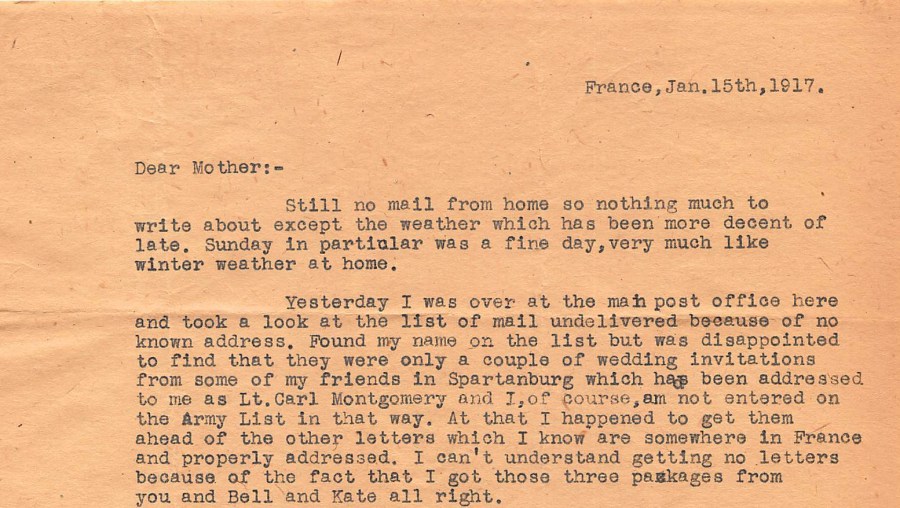
January 15, 1918. “…said she had trouble in getting sugar and white flour….”


[Jan 15 1918] Mid January, Monty is suffering from “no mail.” He’s even been over to the main post office to go through the list of undelivered mail looking for his name. “Found my name on the list but was disappointed to find that they were only a couple of wedding invitations…which had been addressed to me as Lt. Carl Montgomery” and that  was not how he was “entered on the army list.” The annoyance is clear in his statement that “I happened to get them ahead of other letters which I know are somewhere in France and properly addressed.”

His social life is picking up and so is his culinary delight.

Have met some very nice Americans recently who have an apartment here and at dinner there the other night had some real chocolate cake which surely did go good. The lady of the house said she had trouble in getting sugar and white flour so the next day I went to the Commissary Store and got some which was duly donated to the cause of another cake. May say in explanation that officers and men of the American army can purchase small amounts through our Commissary Store.

He hopes “you all are well and that Kenly is getting along well with aviation.”


Transcribed Letter:

France, January 15th, 1917[sic]

Dear Mother:-

Still no mail from home so nothing much to write about except the weather which has been more decent of late. Sunday in particular was a fine day, very much like winter weather at home.

Yesterday I was over at the main post office here and took a look at the list of mail undelivered because of no known address. Found my name on the list but was disappointed to find that they were only a couple of wedding invitations from some of my friends in Spartanburg which had been addressed to me as Lt. Carl Montgomery and I, of course, am not entered on the Army List in that way. At that I happened to get them ahead of the other letters which I know are somewhere in France and properly addressed. I can’t understand getting no letters because of the fact that I got those three packages from you and Bell and Kate all right.

Have met some very nice Americans recently who have an apartment here and at dinner there the other night had some real chocolate cake which surely did go good. The lady of the house said she had trouble in getting sugar and white flour so the next day I went by the Commissary Store and got some which was duly donated to the cause of another cake. May say in explanation that officers and men of the American army can purchase small amounts through our Commissary Stores.

Am no longer attached to Headquarters Lines of Communication but am in the same place. My address is, therefore, unless you receive a cable about it before this letter, Army Post Office 702, AEF.

Hope you are all well and that Kenly is getting along well with aviation.

Love to all,

Carl

Thomas C. Montgomery,

2nd Lt. Inf. U.S.R.

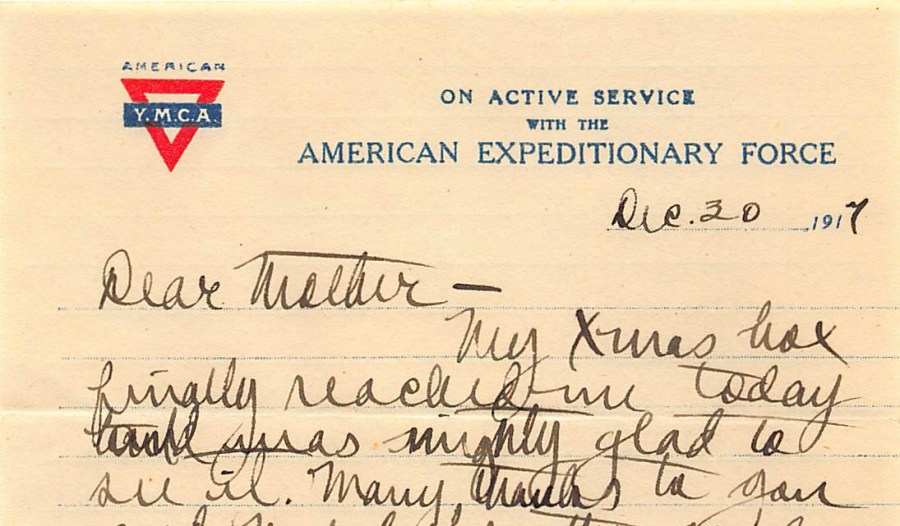
December 30, 1917. “My Xmas box finally reached me today….”

His letter after Christmas—December 30th—begins “My Xmas box finally reached me today and was mighty glad to see it.” He is effusive about the contents including a foot warmer that he doesn’t expect to need until he is sent elsewhere.

The contents are incomplete. “Right to say that somewhere in transit the box was opened and the fruit cake and one box of candy removed.” He nevertheless considers himself lucky to have gotten the box since “a good many have not come through at all.” He proposes having future edibles shipped in a box “wired around” to make it more difficult to open. Despite being “sore” over the loss of the fruitcake—“you know how fond I am of good cake”—he is happy with the “home made candy in particular [which] tasted awfully good—think I recognize Mabel’s fine culinary hand in that.”

He also reports “a box of cigars and some pipe tobacco” that arrived just after Christmas. He’s not sure whether it was intended as a Christmas present or a “part of the regular shipment of cigars and tobacco I requested when I first landed on this side.” He expresses thanks to the parties involved whatever their intent and clarifies: “If you are not shipping the cigars regularly yet, wish you would send a box of 50 every two weeks.” This is his current calculation based on his rate of use and “if one gets lost, it won’t amount to so much.”

He repeats his desire to send money back at least to “meet the interest on my notes, but as long as I am stationed in this large city it will be impossible. My meals here alone—eating at the cheapest places where good food can be procured—cost me about $80.00 a month.” He reflects on the “mail service,” noting that while he is currently overwhelmed with packages, “I still haven’t had a single letter from the States since Mabel’s letter of October 26th.” Nevertheless, he’s had a “fairly cheerful sort of Xmas considering the place and time.

A captain, whom you all know, came here for three days, including Xmas, and it was very pleasant to have an old boyhood friend with me at that time. We roamed around the city quite a bit on Sunday and Xmas day and had an excellent dinner here at the Officer’s Y.M.C.A. Club on Xmas night. The weather was fine on the big day and crowds were out all over the city.

He encloses a copy of his ID photo [not in the envelope] and says “it’s not especially good” and then goes on to describe the Sam Brown Belt which General Pershing requires and which he says distinguishes officers from enlisted men easily. He apologizes in advance for not having time to thank all individually for the Christmas gifts and defers to his mother to handle protocol for allocating thanks.


Transcription:

Dec. 30th, 1917

Dear Mother –

My Xmas box finally reached me today and was mighty glad to see it. Many thanks to you and Mabel for all the good things therein contained – you don’t know how good they do look this far from home. The foot warmer is not needed right now but will come in mighty good when I change station from the city and go back to Camp life. Don’t know when that will happen, if at all, but you are likely to be shipped anywhere in the army. Right to say that somewhere in transit the box was opened and the fruitcake and one box of candy removed. Was and still am pretty sore about losing the fruit cake for you know how fond I am of good cake. However, guess I am fairly lucky to get the rest of the package since as would almost necessarily happen with so many packages coming so far, a good many have not come through at all, being either broken in transit or lost. Would suggest in this connection that if at any time you’re sending me anything else eatable, you might have the box wired around so that it will be difficult to get in. I won’t mind a difficulty at this end in opening it and if it is difficult to get into it will probably not be bothered en route. The homemade candy in particular tasted awfully good – think I recognize Mabel’s fine culinary hand in that.

Yesterday a week ago I got a box of cigars and some pipe tobacco from Kate. Don’t know whether that was intended as a Xmas present or as part of the regular shipment of cigars and tobacco I requested when I first landed on this side. In any event, it was welcome indeed and lots of thanks to Mrs. Brodnax therefor. If you are not shipping the cigars regularly yet, wish you would send a box of 50 every two weeks. That will give me about enough and, sending a box at a time, if one gets lost, it won’t amount to so much. Hope to be able to send some money back to cover these things and meet the interest on my notes some of these days but as long as I am stationed in this large city it will be impossible. My meals here alone – eating at the cheapest places where good food can be procured – cost me about $80 a month.

Another record of another package – got Bell and Horace’s box sent through Wanamaker‘s on Thursday and have been enjoying it a lot. I had about finished it when yours came in today. All the things in it were good and many thanks to the Tilghmans therefor.

You know it’s a funny thing about our mail service – which is still far from satisfactory – but while getting these three packages with in a week, I still haven’t had a single letter from the States since Mabel’s letter written Oct. 26th. Suppose in a few days they’ll blow in all in a bunch. Then I’ll probably go letterless for another month and get another bunch.

Guess by the time I am writing this you receive this, you have received my new mail address by cable, or rather what was and has been my address for the last month. You may have had one of my letters giving it by the time you got the cable but thought I’d cable it to when I found I could cable something like that over the official wires at a reasonable rate. Wanted to send Xmas greetings too but we are given these cheap rates only for business communications.

Had a fairly cheerful sort of Xmas considering the place and time. A captain, whom you all know, came here for three days, including Xmas and it was very pleasant to have an old boyhood friend with me at that time. We roamed around the city quite a bit on Sunday and Xmas day and had an excellent dinner here at the Officers Y.M.C.A. Club on Xmas night. The weather was fine on the big day and crowds were out all over the city.

Nothing much else of interest to write about. Am enclosing small photo made the other day for my identification card as the official photographer gave me an extra one. It’s not especially good but you may observe therein part of the Sam Browne Belt[1] which all officers wear over here. Guess you know something of it. It was adopted by us from the British, being a regulation part of their uniform. General Pershing ordered all officers with the AEF to wear it as it gives an easy distinguishing mark for officers and the people over here have rather a hard time working out our rather complicated insignia. It is composed of a broad leather belt worn – as you see outside the coat – with a shoulder strap attached which goes over the right shoulder being of course attached also in the rear. It also has arrangements on it for carrying pistol, belt and sword when necessary.

Don’t know that I’ll have time to write Kate and Bell and Horace separate letters but please tell them I received their packages O.K. and thank them for me.

You might tell Rebecca[2] we had a pretty good sort of Xmas here.

Love to all,

Carl


O.K.

Thomas C. Montgomery

2nd Lt. Inf. U.S.R.

To repeat my address, it consists of my name and rank as above and –

Headquarters Line of Communications

AEF


[1] Devised originally for a British officer (Sam Browne) who lost his left arm in battle who wanted a means to draw his sword with one hand. Captain (later General) Sam Browne received the Victoria Cross for his actions in the battle that led to the loss of his left arm; some followers wore the belt to acknowledge his bravery. British officers later wore it as a matter of routine. In WWI, General Pershing ordered it for all of his officers to mark the distinction between officers and non-commissioned officers, as Monty describes here in his letter.

[2] Unknown

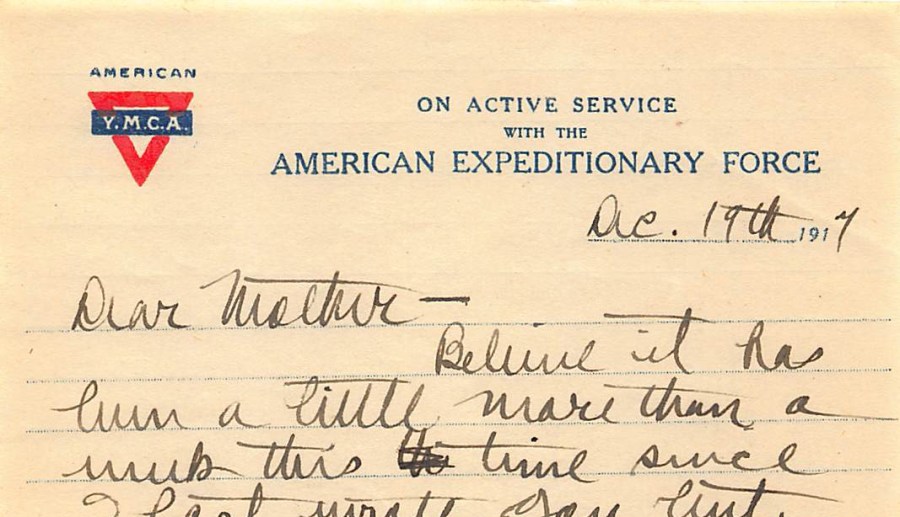
December 19, 1917 “I am actually getting fat over here.”

“…I would have written sooner but that I’ve been kept so busy lately on my new job that I haven’t had sufficient energy to attempt a letter.” He reports the first serious snow and a “service at a famous Cathedral,” apparently forgetting he has already gotten this one past the censor. Either he was bored with the service at the famous Cathedral, of which he “got only an occasional word,” or he was in an exploring mood:

I made a private excursion up into one of the towers where I got a good view of the city and it was beautiful with the snow covered roofs before & below me. Enjoyed my climb all the more as I don’t think visitors are allowed up there but I saw the steps open and rambled up. Probably they wouldn’t have stopped me anyhow as the French are wonderfully polite where an American Officer is concerned.

Christmas is less than a week away. “Shall be thinking of you all on Xmas day, the first I’ve ever missed being at home, and imagining what you are doing.” He doesn’t think he will be working on Christmas and in any case expects a feast to rival the Thanksgiving dinner he reported in a previous letter. He has his thoughts on a couple more slices of mince pie. “Speaking of ‘eats,’ do you know I’m actually getting fat over here—I had to get one uniform let out a bit last week.” He hasn’t had mail from home since getting to Paris—the last being the letter he received from Mabel when he was still at La Valbonne—but he is hoping for more mail soon, “together with that box she spoke of sending,” which he hopes will arrive before Christmas. He again mentions the cost of living; “it surely takes all my salary to live.” He receives “commutation of quarters which covers my room rent but it costs me half my salary for meals.” He closes with the idea that some of his salary could come home, possibly to cover his loans for law school; he’s contemplating this “as soon as I am moved to a less expensive station….”

Transcription:

Dec. 19th, 1917

Dear Mother –

Believe it has been a little more than a week this time since I last wrote you but from what I know of the way the mail goes, you may get this letter by the same mail as my last one or my next one. However, I would have written sooner but that I’ve been kept so busy lately on my new job that I haven’t had sufficient energy at night to attempt a letter.

We had our first snow of any consequence Sunday. That afternoon I went in for a little while to a service at a famous cathedral. A Cardinal was talking and it was interesting though I got only an occasional word of what he said. While there I made a private excursion up into one of the towers where I got a good view of the city and it was beautiful with the snow covered roofs before and below me. Enjoyed my climb all the more as I don’t think visitors are allowed up there but I saw the steps open and rambled up. Probably they wouldn’t have stopped me anyhow as the French are wonderfully polite where an American officer is concerned.

Suppose you are all making your Xmas preparations and this week though guess they are a bit different most places in the States this year. Shall be thinking of you all on Xmas day, the first I’ve ever missed being at home, and imagining what you are doing. Guess about all it will mean here will be one day when we won’t work though I believe they are planning a big Xmas dinner here at the Y.M.C. Officers Hotel. Their Thanksgiving dinner here was mighty good and some more of the mince pie they had then will be mighty good. Speaking of “eats”, do you know I am actually getting fat over here – I had to get one uniform let out a bit last week.

Haven’t had any mail from the States since I moved station three weeks ago, probably because it takes some time to get one’s address changed and for your mail to catch up with you. My last letter from home was Mabel’s, written Oct. 24th but I am hoping more mail, together with the box she spoke of sending, will reach me before Xmas.

Was glad to hear of Aubrey Wheeler’s getting his Majority. The gold leaves are quite becoming to him. Am anxious for more home news to find out what everybody is doing back home. Suppose Kinley has already gone into service now. \

Continue to like living in my new station but it truly takes all my salary to live. I get commutation of quarters which covers my room rent but it costs me half my salary for meals. Understand I can now have part of my salary diverted at Washington and shall have this done as soon as I am moved to a less expensive station so as to send something to Frank to pay interest on my notes but at present it is impossible.

Hoping you are all well and with lots of love,

Carl

PS can you now address my mail to me Hdqtrs Lines of Communication AEF France and I’ll probably get it a little sooner.

O.K.

Thomas C. Montgomery

2nd Lt. Inf. U.S.R.

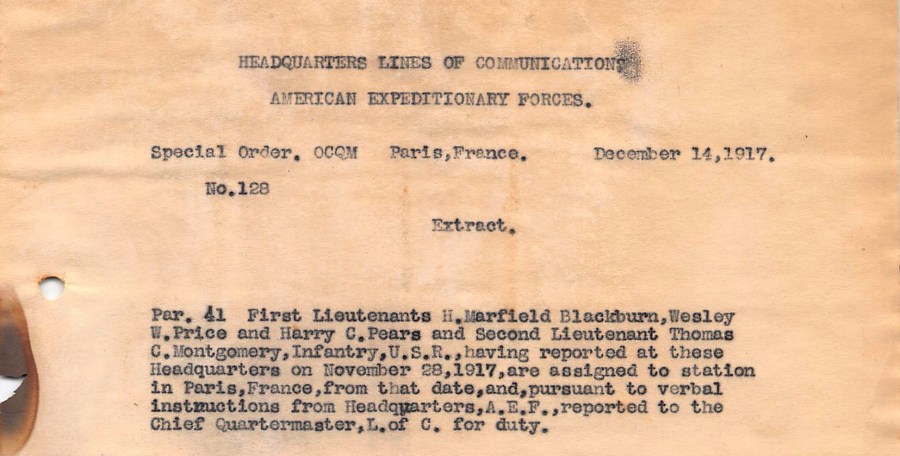
Paris Station – December 14, 1917 Special Order. OCQM No. 128

HEADQUARTERS LINES OF COMMUNICATION.

AMERICAN EXPEDITIONARY FORCES.


Special Order. OCQM                        Paris, France                          December 14, 1917

No. 128


Extract.


Par. 41 First Lieutenants H. Marfield Blackburn, Wesley W. Price and Harry C. Peers and Second Lieutenant Thomas C. Montgomery, infantry, U.S.R., having reported at these Headquarters on November 28, 1917, are assigned to station in Paris, France, from that date, and, pursuant to verbal instructions from headquarters, A.E.F., reported to the Chief Quartermaster, L. of C. for duty.


By command of Major General Kiernan:

Johnson Hagood,

Col. C.A.C.

Chief of Staff

Official:

F. A. Wilcox

Adjutant General

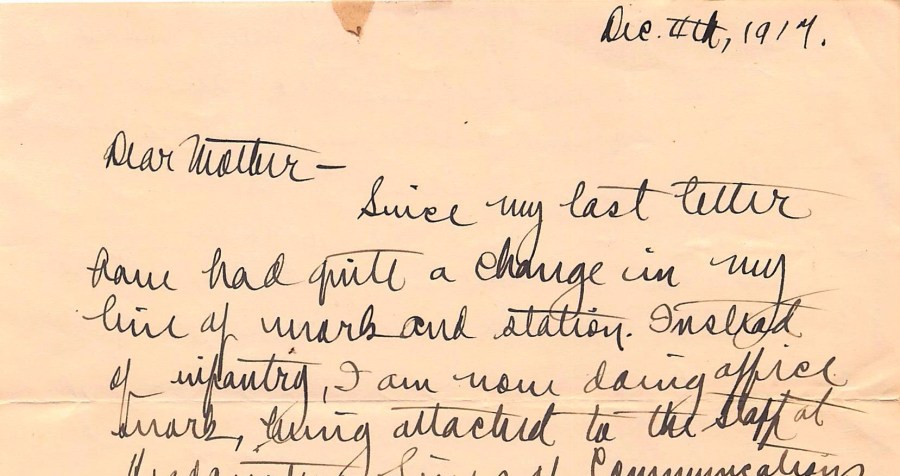
“…it takes every last cent of my salary to live here….”

Monty balanced his good fortune, excitement and celebration with news of something less agreeable. “The only trouble about my new work is that it keeps me entirely too busy to get out for any sightseeing, even on Sundays.” At this point, he seems to have forgotten all about the censor and his concern about telling too much. He writes, “last Sunday, I got out and had a look at the Tomb of Napoleon and the Cathedral of Notre Dame.” One senses that French word order has affected his English. After saying he can never know how long his assignment will last, he writes: “I like it all very well but it takes every last cent of my salary to live here—as in our big cities.”

The list of negatives lengthens. “Another trouble about being here is that I guess my mail will chase me to my last station and then back here before receiving it. However, you soon get used to all these things in the army and I am really enjoying my new quarters.” He sends “Xmas wishes to all the family and kinfolks.”

Transcription:

Dec. 4th, 1917

Dear Mother –

Since my last letter have had quite a change in my line of work and station. Instead of infantry, I am now doing office work, being attached to the staff at headquarters, Lines of Communications. Also, instead of being in a rather cold and disagreeable place, I am now in a most interesting place where I have steam heat and hot and cold water in my bedroom and live much as I did at home. Was assigned to this work just before Thanksgiving which I spent here very pleasantly, having a real “homey” sort of dinner at the Officer’s Club, served by American ladies who live here, and which I finished with two pieces of wonderful mince pie. The only trouble about my new work is that it keeps me entirely too busy to get out for any sightseeing, even on Sundays, although last Sunday I got out in the afternoon and had a look at the Tomb of Napoleon and the Cathedral of Notre Dame. Have no idea how long I’ll be here nor whether I’ll be continued in my present line of work for any length of time – one never knows in the Army. I like it all very well except that it takes every last cent of my salary to live here – as in our own big cities.

Another trouble about being here is that I guess my mail will chase me to my last station and then back here before receiving it. However you soon get used to all these things in the army and I am really enjoying my new quarters.

Don’t know whether this will reach you by Xmas or not but again all Xmas wishes to all the family and kinfolks.

With love,

Carl

O.K.

Thomas C. Montgomery, 2nd Lt. Inf. U.S.R. P.S., Leave of [sic] the BCM in my address now – make it, Thomas C. Montgomery 2nd Lt. Inf. U.S.R., AEF Paris France.

“…packages of Prince Albert…for my pipes.”

November 26, 1917

Dear Mabel –

Since writing mother yesterday from this neighboring city came back to camp and found your letter of Oct. 26th, enclosing the kodak pictures, and surely enjoyed it. All the home news looked mighty good to me.

Glad to hear Kenley has got into aviation finally and feel sure he will find it congenial. There are several aviation camps in this vicinity and several machines are in sight most of the time.

You ask whether I am in France but suppose you know by now I am and have been here since Oct. 6th. Some of my letters should have reached you soon after my letter from the place where I landed. Hope, as aforesaid, that you got one of my letters about cigars and that some will soon reach me. Other things for my comfort I can buy here as well as at home. Wish you would include with this box of cigars a week 2 or 3 packages of Prince Albert tobacco for my pipes.

Sorry to hear your farm sale was not satisfactory and hope you will find a good sale this winter.

[Carl’s letter to Mabel concludes here with no closing salutation. Missing pages?]

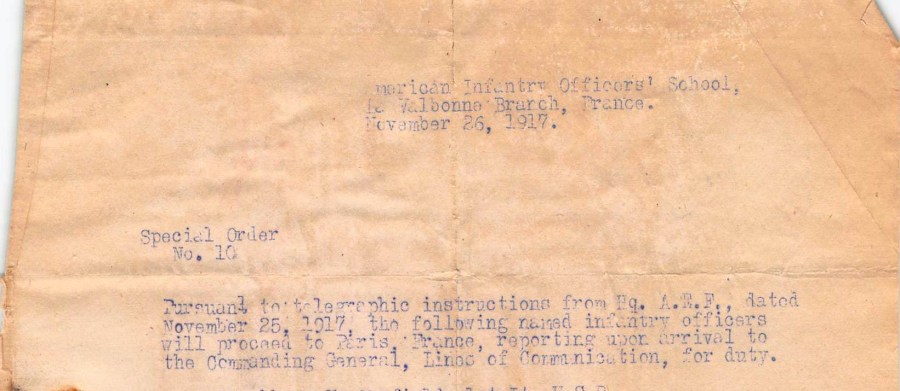
Special Order No. 10, November 26, 1917

“Definite orders” are issued November 26, 1917:

American Infantry Officers’ School,

La Valbonne Branch, France.

November 26, 1917.


Special Order

No. 10


Pursuant to telegraphic instructions from Hq, A.E.F., dated November 25, 1917, the following named infantry officers will proceed to Paris, France, reporting upon arrival to the Commanding General, Lines of Communication, for duty.

[Sixteen names including]

Montgomery, Thomas C, 2nd Lt. U.S.R

. . . .

The travel directed is necessary in the military service. [no date for travel or arrival]

A.B. Drum

Major, U.S.M.C.


November 25, 1917–“definite orders in a day or two”

By November 25, Monty has made it into “this city near our camp” for a “film from the States.” This is otherwise a turning point because he is “under orders to move this next week though I don’t know where as yet—guess I’ll get definite orders in a day or two.” He’s an infantry lieutenant, so the possibilities are clear. All he says is that he doesn’t “know if the change will be for better or worse.” He’s also calculating the time it takes for mail to move around. “Hope you got my letter about sending me some cigars and that I’ll soon receive them.” He is also contemplating an ideal delivery cycle for the cigars that he imagines en route to him. “Guess it will be a better idea to send a box a week instead of four boxes a month as if any get lost it will be only one week’s supply.”

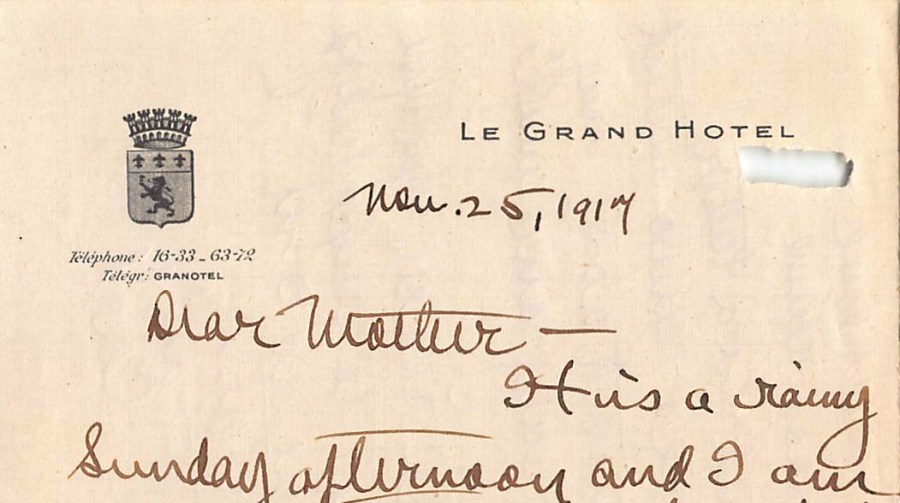
Doubtless written during his foray into town, or on stationery he picked up while there, the letterhead above his sepia cursive identifies its origin as Le Grand Hotel, a perfectly generic hotel name beneath which he has carefully snipped out the city name. However, the rampant lion and the three gold fleur-de-lis of the coat of arms reveal the city—Lyon. This would seem to confirm that he was at the training center at La Valbonne, twenty miles from Lyon. His military records agree that he attended an infantry school at La Valbonne from October 8 through November 27, 1917.


Transcript:

[Letterhead: Le Grand Hotel (coat of arms – Lyon) Téléphone: 16-33_63-72 Télégr: GRANOTEL (Monty has snipped out a small rectangle probably Lyon in order to keep with his interpretation of the censor’s constraint on divulging locations.)]

November 25, 1917

Dear Mother –

It’s a rainy Sunday afternoon and I am enjoying sitting in front of an open fire in my hotel in this city near our camp after having been to a movie. The best part of the movie was a film from the states and you may be sure all Americans in the theater enjoyed it thoroughly.

Last night when I came in, I ran into a Doctor, a captain in the Hospital Corps, who was loafing here on a few days leave and we have been knocking around together since. He came over with the first troops in June – is, by the way, from the staff at Johns Hopkins – and had a number of interesting things to tell me about the first expedition etc.,

I am now under orders to move this next week though I don’t know where as yet – guess I’ll get definite orders in a day or two. Don’t know whether the change will be for better or worse but I am hopeful as usual. It will at least be a change from what I have been doing since reaching France.

Still have heard nothing further from home. Had a letter last Monday from my girl in Mississippi written Oct. 21st in which she said she got my cable on the 19th or two weeks after you received yours. Don’t understand the difference as both were sent at the same time. You both should have received some of my letters at least a month ago. Hope you got my letter about sending me some cigars and that I’ll soon receive them. Guess it will be a better idea to send a box a week instead of four boxes a month as if any get lost it will be only one week’s supply.

This letter should reach you before Xmas so a Merry Xmas to everybody & don’t worry about me as I am getting along all right.

Love to all,

Carl

November 16, 1917 — “Sale of the Farm”

On November 16, Monty enthusiastically welcomes his first letter from home. “Your letter of Oct. 6 was received last Saturday [November10] and was mighty glad to get it as it was my first news from you since sailing.” The rest is how much he’s seen and done—including a three-day trip he wants to tell about “but again the censor prevents.” And about the cold weather. He’s “become so well accustomed to this rain & damp cold that I mind it very little any more.” All safe topics. His mother, now five years into widowhood at the age of 60, has among other things relayed that she’s selling the farm. “Hope your sale of the farm was entirely successful…,” he concludes.


Transcript:

November 16, 1917

Dear Mother —

Your letter of Oct. 6th was received last Saturday and was mighty glad to get it as it was my first news from you since sailing. Have been looking for other letters since as you should have received some of my letters from this side by Oct. 15 or 20th – however nothing more as yet. Have been writing you every week since landing on this side but the mail seems to be so uncertain that I don’t know whether or not you have received them. If you have got some of them you will know that I am not permitted to tell you anything much about what I have seen or am doing. Wish the censorship did not prevent my writing as I want to for, if so, there would be plenty of material for letters.

Just returned this morning from a three day trip – the longest leave I’ve had since landing – in which I visited some very interesting places and altogether had a wonderful time. Wish I could tell you all about it but again the censor prevents

Have continued in my usual health and have become so well accustomed to this rainy & damp cold that I mind it very little any more.

Had a letter this morning from Charlie Anderson in which he spoke of having heard from Edith as late as October 12th. Was surprised to find he was over this side – guess he must have come very soon after I did. Hope your sale of the farm was entirely successful and that Kenly has his affairs straightened out by now.

Love to all,

Carl

OK

Thomas C. Montgomery

2nd Lieut. Inf. U.S.R.